
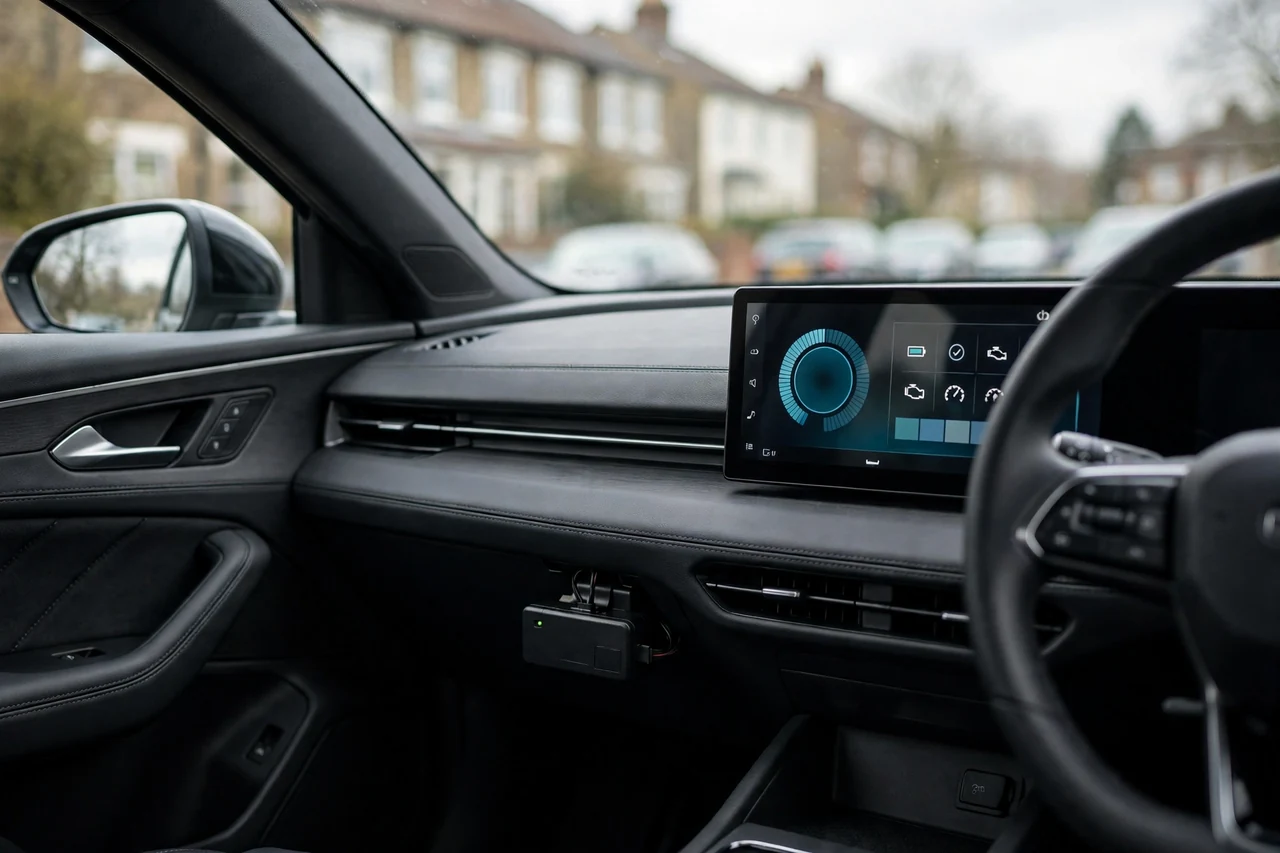
For decades, car insurance worked on broad assumptions: your age, your postcode and the type of car you drive decided what you paid, whether you were careful behind the wheel or not. Black box car insurance turns that model on its head. Instead of guessing how you might drive, the insurer watches how you actually drive, using telematics technology fitted to your car or running on your phone, and prices your premium around your real behaviour. It is one of the clearest examples of technology reshaping a traditional industry, and it is steadily moving from a niche product for teenagers into the mainstream of UK motoring.
What Is Black Box Car Insurance?
Black box car insurance, often called telematics insurance, is a policy that monitors your driving through a small device installed in your vehicle, a plug-in unit, or a smartphone app connected to the car. The system records things like your speed, braking, acceleration, cornering, mileage and the times of day you travel. That data builds a driving score, and your insurer uses the score to set or adjust your price.
The idea is simple fairness: careful drivers should not have to subsidise careless ones. A young driver who drives gently, avoids late-night journeys and keeps mileage low can prove it with data rather than waiting years to build up a no-claims record. In the same way that connected technology is changing car ownership more broadly, telematics shifts insurance from static risk categories to live, personal evidence.
How the Telematics Technology Works
The original black box was a physical unit, roughly the size of a smartphone, fitted out of sight by an engineer or posted to you as a self-install plug-in. Modern policies increasingly skip the hardware altogether. Many insurers now use an app that pairs with your phone’s GPS and motion sensors, or a small tag that sticks to the windscreen and talks to your phone over Bluetooth.
Whichever format is used, the data collected is similar. Accelerometers detect harsh braking and rapid acceleration. GPS tracks routes, speeds and journey times. The insurer’s software converts these signals into a score, usually visible to you in an app dashboard, with feedback on where you are losing marks. Some policies reward good scores with monthly discounts or cashback; others set the renewal price based on the year’s driving record. A few policies still impose conditions, such as higher excesses for regular night-time driving, so the details are always worth reading before you buy.
Who Benefits Most from a Black Box Policy?
Young and newly qualified drivers remain the biggest winners. Traditional premiums for under-25s are painfully high because, statistically, that age group claims more often. A telematics policy lets an individual young driver step out of the stereotype: drive well for a few months and the data argues your case for a cheaper renewal far better than any phone call could.
They are not the only audience, though. Low-mileage drivers, people who mainly drive outside rush hour, and households adding a second car can all benefit. Drivers returning after a claim or a conviction sometimes use a black box policy to rebuild their record at a manageable price. And as the wider cost of running a car keeps climbing, plenty of ordinary motorists are happy to trade a little data for a meaningful saving.
The Downsides and Privacy Questions
Telematics is not for everyone. The obvious concern is privacy: a black box policy means your insurer knows where your car goes and when. Insurers state that data is used for pricing and claims purposes, and UK data protection law applies, but if the idea of being tracked makes you uncomfortable, a conventional policy may suit you better.
There are practical catches too. Scores can feel unforgiving: one emergency stop to avoid a hazard may register as harsh braking, even though it was good driving. Night-shift workers can be marked down for travelling at hours the model treats as risky. Some policies charge if you exceed an agreed mileage cap or cancel mid-term. Reading the scoring rules before you sign up matters as much as comparing the headline price, in the same way that understanding what a service actually includes matters when you compare MOT and servicing options.
How Telematics Is Changing the Wider Market
The influence of black box car insurance reaches beyond the drivers who hold these policies. The huge volumes of driving data insurers now hold are refining risk models for everyone, and the feedback loop is changing behaviour: drivers who can see their score tend to drive more smoothly, which is good news for road safety as well as premiums.
Telematics is also merging with the connected car itself. Many modern vehicles, especially electric models, already record rich driving data, and insurers are beginning to offer policies that draw directly on the car’s own systems with the owner’s permission. As EV servicing and connected diagnostics become normal, the line between the car’s software and the insurance policy will blur further. Usage-based cover, priced per mile or per journey, is a natural extension, and it suits the growing number of people who drive less than they used to.
Getting the Most from a Black Box Policy
If you take out a telematics policy, treat the score as a coach rather than a judge. Accelerate gently, leave bigger gaps so you brake less sharply, and avoid very late journeys where your policy penalises them. Check the app regularly: most drivers are surprised by which habit costs them the most marks, and it is usually easy to fix.
It also helps to keep the rest of your motoring life in order. Insurers still look at the whole picture, and a car that is maintained properly is less likely to be involved in the kind of incident that wrecks a score. Whether that is through a traditional garage or one of the growing mobile auto services that come to your home, regular care supports the careful-driving story your data is telling. Finally, shop around at renewal: a year of strong scores is a valuable asset, and rival insurers will often compete for a driver who can prove they are low-risk.
Black box car insurance will not replace conventional cover overnight, but its direction of travel is clear. Pricing based on evidence rather than assumptions is fairer, and the technology behind it is becoming invisible, built into the apps and vehicles drivers already use. For anyone quoted a premium that feels detached from how they actually drive, telematics offers something genuinely new: the chance to let your driving speak for itself.