
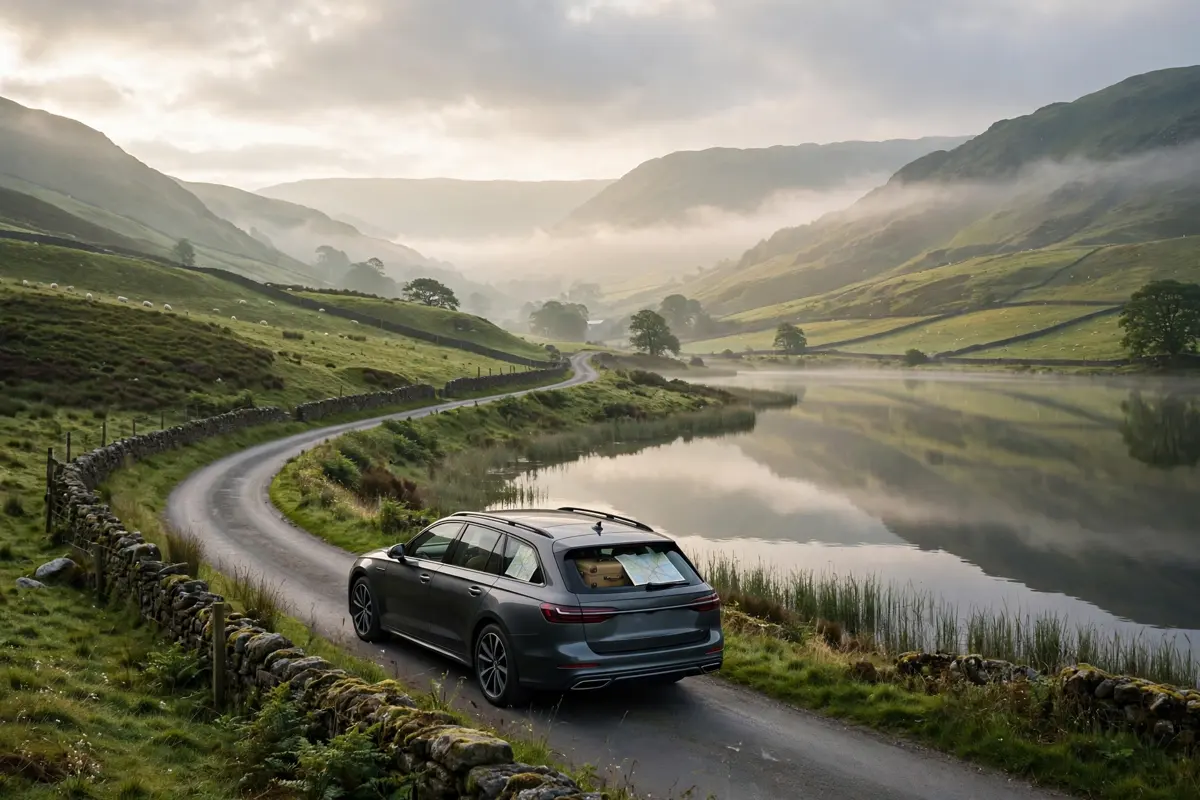
A great British road trip rarely happens by accident. If you want to plan a UK road trip that feels relaxed rather than rushed, the secret is deciding the big things early: your route, your nightly stops, your budget and the state of your car. The UK is compact compared with many countries, yet its mix of motorways, single-track lanes, coastal roads and historic towns means journey times can surprise you. This guide walks through each step, from sketching a route to packing the boot, so the drive itself becomes part of the holiday rather than something to endure between stops.
Start with a route you can actually enjoy
The most common mistake is trying to see everything. Distances look short on a map, but a cross-country day that mixes motorway miles with slow rural roads is tiring, and you will arrive too late to enjoy the place you drove to. A better approach is to pick one region and explore it properly, or to build a loop with no more than two to three hours of driving on most days. Classic loops include the North Coast 500 in Scotland, a circuit of the Lake District and Yorkshire Dales, the Cornish coast, or a run through Snowdonia and down the Welsh coast.
When you plan a UK road trip route, work backwards from your overnight stops. Book accommodation in small clusters so you can spend two nights in one base and take day trips from it, instead of packing and unpacking every morning. If you are still deciding where to stay, our guide on how to choose a hotel for a city break covers what to check before you book, and much of the same thinking applies to rural inns and guesthouses: parking, check-in times and breakfast hours matter more on a road trip than thread counts.
Set a realistic road trip budget
Fuel is only one part of the cost. A sensible budget has five lines: fuel, accommodation, food, attractions and a contingency for the unexpected, such as a paid car park in a honeypot village or a toll road. Build the fuel estimate from your total mileage and your car’s real-world economy rather than the brochure figure, then add a margin for detours, because there will always be a viewpoint, a farm shop or a beach that pulls you off the main road.
Accommodation is usually the biggest cost, and it rewards early booking in popular areas during school holidays. Food costs drop quickly if you mix one proper restaurant meal a day with picnic lunches from local bakeries and markets, which also tend to be more memorable than motorway services. Keep the contingency line even if everything goes smoothly; it turns a minor problem, such as a lost phone charger or a puncture repair, into an inconvenience instead of a crisis.
Get the car ready before you set off
A road trip magnifies small faults. A slow puncture that survives a week of commuting can end a holiday on a remote moorland road, so give the car a proper check at least a week before departure. Look at tyre tread and pressures, including the spare if you have one, top up screenwash, test all the lights and check oil and coolant levels. Our article on how smart tyres are changing road safety explains what modern tyre checks involve, and it is worth understanding what a garage looks for before you book.
If a service is due within the next couple of thousand miles, bring it forward. Understanding what really drives UK servicing prices helps you judge quotes sensibly rather than simply picking the cheapest. It is also worth knowing whether your car is due an MOT during the trip; our guide to MOTs in the digital age explains how testing and servicing now fit together. Electric car drivers should plan charging around overnight stops rather than relying on rapid chargers at busy services, and our overview of EV servicing and maintenance is a useful refresher on what differs from a petrol car. Finally, if something minor does go wrong away from home, remember that mobile auto services can often come to you, which beats losing a day to a garage queue in an unfamiliar town.
Pack for British weather, not the forecast
The forecast will change, possibly before lunch. Pack in layers and keep waterproofs in the cabin rather than buried under luggage, because the rain usually arrives while you are already out exploring. A simple system works well: one bag for clothes, one small day bag for walks, and a boot organiser for the things that otherwise migrate around the car, such as charging cables, snacks, a torch, a first aid kit and a paper map for the areas where phone signal disappears.
Download offline maps and your accommodation details before you leave, and keep a phone charger that works from the car. If you are travelling with children or a dog, plan stops every ninety minutes or so; the trip will feel shorter for everyone, and you will notice far more of the countryside you came to see.
Plan your driving days, not just your route
A route on a screen says nothing about how a day will feel. Two hundred miles of motorway is a relaxed morning; the same distance on Highland single-track roads or Cornish lanes is a full and tiring day. As a rule of thumb, treat three hours behind the wheel as a comfortable touring day and five as an absolute maximum, and remember that average speeds on rural UK roads are far lower than the speed limit suggests. Build in a stop roughly every ninety minutes, ideally somewhere with a reason to get out: a market town, a viewpoint, a castle ruin or simply a bakery.
Think about light as well as distance. In midwinter it is dark by late afternoon in the north, which argues for shorter hops and earlier arrivals, while long summer evenings let you add an after-dinner drive to a coastal sunset. If you are sharing the driving, agree the swaps in advance so nobody ends up doing every difficult stretch. The aim is to arrive at each stop still pleased you came, rather than relieved the day is over.
Leave room for the unplanned
The final step when you plan a UK road trip is to resist filling every hour. The best moments are usually unscripted: a village show, a steam railway, a beach you spotted from the road. Build slack into the plan, keep one afternoon unscheduled in each base, and let the trip breathe. With a sensible route, an honest budget, a checked car and a boot packed for any weather, the miles between stops become the part you talk about when you get home.