EV servicing is becoming an increasingly important part of the UK automotive aftermarket as more motorists move towards electric vehicles. Although electric cars have fewer conventional drivetrain components than petrol and diesel vehicles, they still require inspections, maintenance, diagnostics and specialist repairs.
The biggest change is the technology involved. Electric vehicles rely on high-voltage battery systems, electric motors, power electronics, software and sophisticated electronic controls. As a result, workshops need new skills and equipment alongside the mechanical expertise they have traditionally used.
For automotive service businesses, this creates a major opportunity. Workshops that prepare for electric vehicle maintenance can serve a growing range of vehicles while developing capabilities that will become increasingly important as the UK vehicle market changes.
Why EV Servicing Is Becoming More Important
Electric vehicles are fundamentally different from conventional cars. They do not use a petrol or diesel engine, conventional exhaust system or many of the engine-related components found in internal-combustion vehicles.
However, that does not mean an EV is maintenance-free. Tyres, brakes, suspension, steering, cooling systems, charging components and other vehicle systems still need appropriate inspection and maintenance.
The difference is that electric vehicles add high-voltage electrical systems to the workshop environment. The Health and Safety Executive states that electric and hybrid vehicles can contain high-voltage components and cabling capable of delivering a fatal electric shock, as well as stored electrical energy and other hazards.
This makes specialist training and safe working procedures central to modern EV maintenance.
What EV Servicing Actually Involves
There is no single service procedure that applies to every electric vehicle. Manufacturers use different battery architectures, motors, thermal-management systems, software and charging technologies.
A typical EV maintenance programme may involve checking the vehicle’s general condition, tyres, brakes, suspension, steering, lights, cooling systems and charging equipment. Depending on the vehicle and manufacturer, technicians may also need to assess battery-related systems and electronic fault information.
The exact requirements should always be based on the manufacturer’s service schedule and technical information. Electric vehicles vary considerably, so workshops should avoid assuming that one model’s maintenance procedure applies to another.
Tyres and wheel condition
Tyres remain particularly important on electric vehicles because battery packs can contribute substantial vehicle weight. Correct tyre specification, inflation and condition should therefore remain a routine part of vehicle inspections.
Wheel alignment can also influence handling, tyre wear and vehicle efficiency. As workshop technology develops, digital inspection and alignment equipment can help technicians identify issues more consistently.
Braking systems
Many EVs use regenerative braking to recover energy while slowing the vehicle. This can change how frequently conventional friction brakes are used, but it does not remove the need for brake inspection.
Brake components can still deteriorate through age, corrosion, contamination and normal use. Workshops should therefore inspect the braking system according to the vehicle manufacturer’s requirements rather than assuming that regenerative braking eliminates maintenance.
Cooling and thermal management
Electric vehicles use thermal-management systems to control temperatures within components such as batteries, electric motors and power electronics. Maintaining the appropriate system can be important for vehicle performance and component longevity.
Because cooling architectures differ between models, technicians need access to the correct technical information and procedures.
EV Mechanics Need New Technical Skills
The move towards electric vehicles is changing the role of the automotive technician. Traditional mechanical skills remain valuable, but EV mechanics also need knowledge of electrical systems, vehicle electronics and high-voltage safety.
The National Careers Service identifies electric and hybrid vehicle system repair and replacement as a specialisation available to motor mechanics. Its current career guidance also notes that technicians working with hybrid or electric vehicles may work with high-voltage batteries and can specialise further through additional training.
Training requirements depend on the type of work being performed. A technician carrying out general maintenance around an EV does not necessarily need the same competence as someone working directly on high-voltage electrical systems.
The HSE similarly explains that the level of competence required depends on the work being undertaken and distinguishes between general activities, maintenance and repair, and work directly involving high-voltage electrical systems.
This means workshop owners need to understand the capabilities of their teams rather than treating EV training as a single qualification or one-off exercise.
Battery Servicing Is Becoming a Specialist Area
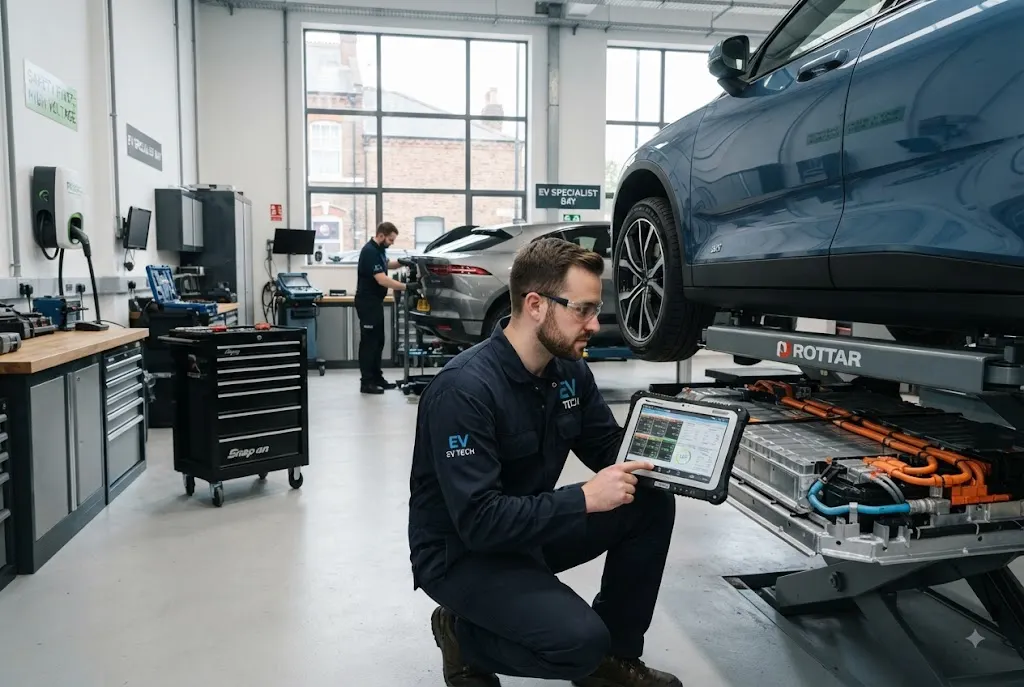
The traction battery is one of the most important components in an electric vehicle. It stores the electrical energy used to power the vehicle and works alongside battery-management and power-control systems.
Battery servicing does not necessarily mean opening or replacing the battery pack. In many cases, workshop attention may involve diagnostic assessment, inspection, thermal-management checks or investigating fault information.
More complex battery work can require specialist equipment, procedures and competence. Damaged or faulty high-voltage components should not be approached like conventional mechanical parts.
The HSE highlights several risks associated with electric and hybrid vehicle batteries, including stored electrical energy, potential fire or explosion hazards, harmful substances and manual-handling risks during battery replacement.
For this reason, businesses considering battery servicing need to assess their workshop facilities, equipment, training and safety procedures before taking on advanced work.
EV Diagnostics Will Become More Important
Diagnostics are central to modern electric vehicle maintenance because so many vehicle functions are electronically controlled. A warning light may relate to software, sensors, battery management, power electronics, charging systems or another electronic component.
A diagnostic scan can provide useful information, but it should not automatically be treated as a complete diagnosis. Technicians still need to interpret codes and data, perform appropriate tests and establish the underlying cause of a problem.
This is where the development of connected workshops becomes important. Digital systems can bring vehicle information, diagnostic results, inspection records and customer communication together.
The wider trend towards automotive service companies using connected workshop technology is therefore closely linked to EV maintenance. The more software-dependent vehicles become, the more important information management becomes for workshops.
Charging Infrastructure Is Part of the EV Service Ecosystem
Electric vehicle ownership is closely connected to charging. Drivers may charge at home, at workplaces or through public charging networks, and problems with charging can affect how useful an EV is to its owner.
Workshops may increasingly encounter charging-related issues alongside conventional maintenance. Depending on the business and its qualifications, this could involve checking vehicle charging components, identifying fault symptoms or working with specialist charging equipment.
However, vehicle maintenance and electrical installation work are not automatically the same thing. Businesses should ensure that any work involving charging infrastructure is carried out by appropriately competent professionals and follows the relevant requirements.
For EV service companies, understanding the wider charging ecosystem can nevertheless improve customer conversations. A motorist experiencing a charging problem may need help distinguishing between a vehicle issue, a charger issue, a cable problem or an external electrical supply problem.
Connected Mobility Is Changing the Workshop Model
Electric vehicles are part of a broader shift towards connected mobility. Modern vehicles can collect and process significant amounts of information through onboard systems, while software increasingly influences vehicle functions.
This creates opportunities for more data-driven maintenance. In the future, connected vehicle information could help identify changes in vehicle condition before a driver notices a serious problem.
For workshops, the challenge will be gaining appropriate access to useful information while maintaining data security and clear customer permissions.
Connected servicing could also make customer communication more proactive. Instead of waiting for a vehicle owner to notice a problem, a service business could potentially use relevant vehicle information to recommend an inspection when appropriate.
These developments are likely to complement rather than replace physical inspections. A connected vehicle can provide information, but technicians still need to verify faults and assess components in the real world.
How EV Servicing Differs from Traditional Car Maintenance
The differences between EVs and conventional vehicles can be seen across the entire service process.
Traditional vehicles often require maintenance related to engines, exhaust systems, oil systems, fuel systems and other combustion components. EVs eliminate many of these requirements, but introduce high-voltage electrical systems, traction batteries, electric motors and different electronic architectures.
This can change the balance of workshop work. Some routine maintenance may become simpler, while diagnostics and electrical expertise become more important.
That does not mean EV workshops will stop needing mechanical technicians. Suspension, steering, tyres, braking systems and many other components remain essential. Instead, the modern EV technician is likely to need a broader combination of mechanical and electrical knowledge.
EV Servicing and Workshop Safety
Safety should be one of the first considerations for any business expanding into EV maintenance. High-voltage systems introduce risks that require specific procedures and competent personnel.
The HSE advises that technicians should use vehicle-specific information from manufacturers and trade bodies, inspect vehicles for signs of high-voltage cable or component damage and isolate or disconnect high-voltage batteries in accordance with manufacturer instructions when the task requires it.
Workshop procedures should also consider key management, vehicle movement, damaged batteries and the safe storage or handling of relevant components.
This is particularly important because an electric vehicle can be silent when powered and may contain dangerous electrical energy even when it appears to be switched off.
Businesses should therefore develop clear procedures for identifying EVs, assessing risks and ensuring that only appropriately competent people undertake higher-risk work.
Training the Next Generation of EV Mechanics
Training availability is expanding as the automotive industry responds to electric vehicle growth. Current National Careers Service listings include courses covering electric and hybrid vehicle system repair and replacement, as well as more advanced diagnosis, testing and repair qualifications.
This gives workshops more options for developing internal capabilities. Businesses can gradually build skills according to the type of EV work they intend to perform.
Training can also help existing technicians adapt rather than requiring workshops to replace their workforce. A mechanic with strong mechanical experience may already have valuable knowledge that can be combined with additional EV-specific electrical training.
For workshop owners, the objective should be to match training levels to actual responsibilities. Staff who only encounter EVs during general maintenance need different preparation from technicians performing high-voltage diagnosis or component replacement.
EV Servicing and the Future of Smart Transport
The growth of electric vehicles is connected to wider changes in transport. Smart transport systems, connected vehicles, digital payments, public charging networks and increasingly intelligent infrastructure are gradually changing how motorists interact with mobility.
Workshops will become part of this ecosystem rather than operating separately from it.
A future service visit could involve more digital information before the vehicle arrives, automated diagnostic data during inspection and a digital record after work is completed. The workshop may also need to understand charging behaviour and software-related issues alongside physical vehicle maintenance.
This is why the move towards garage chains going digital is relevant to the EV market. Digital infrastructure can help large service networks coordinate increasingly complex vehicle information across multiple locations.
How Independent Garages Can Prepare for EV Growth
Independent garages do not necessarily need the same scale of investment as large national networks, but they do need a clear strategy.
The first step is understanding local demand. A garage can assess how many EVs and hybrids are entering its customer base and which manufacturers are most common in the area.
The next step is technician development. Businesses should identify which staff members can undertake general EV-related work and which require additional training for higher-risk tasks.
Equipment should then be considered alongside training. Diagnostic tools, insulated equipment and other specialist resources need to match the types of vehicles and work the business intends to support.
Finally, customer communication matters. EV owners may have questions about battery health, charging problems, braking, tyres and servicing intervals. A garage that can explain these subjects clearly can build confidence without making unnecessary promises about battery life or repair costs.
What the Future of EV Servicing Could Look Like
The future of EV servicing is likely to combine physical workshop expertise with digital diagnostics and connected vehicle information.
Battery technology will continue to develop, while software and electronic systems will remain central to electric vehicle operation. Workshops may therefore rely increasingly on advanced diagnostic platforms and manufacturer information.
Artificial intelligence could eventually support technicians by analysing large volumes of vehicle data, identifying patterns and helping prioritise possible faults. However, professional judgement and physical verification will remain important for safety-critical work.
Meanwhile, charging infrastructure will continue to influence the ownership experience. Workshops that understand both vehicle-side charging issues and the limits of their own electrical expertise will be better positioned to guide customers.
The most successful EV service businesses are unlikely to be defined by technology alone. They will combine qualified people, appropriate equipment, strong safety procedures and a customer experience that makes complex technology easier to understand.
Conclusion
EV servicing is becoming a core capability for the modern UK automotive aftermarket. Electric vehicles may remove many traditional engine-related maintenance requirements, but they introduce high-voltage batteries, electric motors, sophisticated electronics and new diagnostic challenges.
For workshops, the transition requires investment in technician training, specialist equipment, manufacturer information and safety procedures. Current UK training pathways already include dedicated qualifications for electric and hybrid vehicle repair, while the HSE provides specific guidance on the risks and competencies involved in working with these vehicles.
As connected mobility and charging infrastructure develop, EV maintenance will become part of a much broader digital automotive ecosystem. Workshops that combine traditional mechanical expertise with electrical knowledge and connected servicing capabilities will be well placed to support the changing vehicle market.
The future of EV maintenance is therefore not simply about servicing electric cars. It is about building a new generation of automotive service businesses capable of working safely and confidently with increasingly connected, software-driven and electrically powered vehicles.