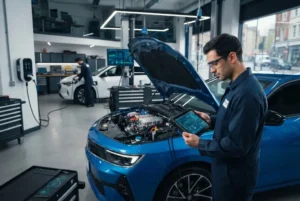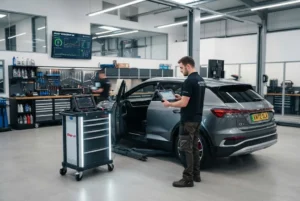

A car’s service history used to live in a booklet in the glovebox, stamped by hand at each visit. Today, that record is increasingly digital, and the change matters more than it first appears. Service history in digital form promises a complete, trustworthy and easily shared account of how a car has been maintained. This guide explains what digital service history means, how it works, why it matters for resale value and ownership transparency, and what to watch out for as paper records give way to digital ones.
From Paper Booklets to Digital Records
For decades, a service booklet was the proof that a car had been looked after. Each service added a stamp, a date and a mileage reading, and a buyer could flick through the booklet to judge how carefully the car had been maintained. The system worked, but it had weaknesses: booklets could be lost, damaged or, in the worst cases, falsified, and a booklet told you little about what work had actually been done beyond the stamp.
Digital service records change that picture. When a garage records a service digitally, the entry typically includes the date, mileage, work performed and parts used, stored in a system that the owner, the garage and sometimes the manufacturer can access. That richer record is harder to lose and harder to fake, and it can be shared instantly when a car is sold. For buyers, that means greater confidence. For owners, it means a maintenance story that is complete even if paperwork goes missing.
How Digital Service History Works
Digital service history works through a combination of garage systems, manufacturer databases and, increasingly, connected car technology. When a car is serviced, the garage logs the work in its own system and, for many makes, in the manufacturer’s central record as well. The owner may be able to view that record through an app or an online account, and an approved garage can retrieve it when the car next visits, even if it has moved to a different workshop.
Connected cars add another layer. Modern vehicles monitor their own condition and can report service needs directly, so the record reflects what the car actually experienced rather than only what a human remembered to write down. This connected ownership model is part of a wider shift in motoring, where data plays a growing role in how cars are maintained. Our coverage of auto services and vehicle maintenance explores how technology is changing workshops and ownership together.
Why Digital Service History Matters for Resale Value
A complete service history has always supported resale value, and digital records strengthen that effect. Buyers pay more for cars whose maintenance they can verify, because verified maintenance reduces the risk of hidden problems. A digital record that shows regular servicing, at sensible intervals, by competent garages, is one of the strongest signals a seller can offer.
The effect is especially clear for premium and nearly new cars, where buyers are particularly careful, but it applies across the market. A car with a patchy or missing history invites suspicion and lower offers, while a car with a complete digital record invites confidence. Keeping that record complete is therefore not only good maintenance; it is good financial sense. It is also worth remembering that servicing costs themselves vary, and our guide to car service costs explains what drives garage bills, so you can judge whether a digital-record service represents fair value.
Ownership Transparency and Trust
Digital records also improve transparency between owners, garages and buyers. When the work performed is recorded in detail, there is less room for misunderstanding about what was done and what was charged. Owners can check their own records, garages can see a car’s full history before advising on new work, and buyers can verify claims a seller makes. That transparency builds trust across the whole ownership chain.
There are limits, of course. A digital record is only as good as the data entered into it, and not every garage uses the same system. Independent garages may record work in their own systems rather than a manufacturer’s database, which can fragment the record. Owners should therefore keep their own notes as well, including invoices and receipts, so that the full picture survives even if systems differ. The goal is a record that is complete, accessible and believable, whatever combination of systems holds it.
Digital Records, Privacy and Control
As with any digital system, privacy and control deserve attention. Service records contain information about where a car has been and when, and owners should understand who can access that information and for what purpose. In practice, access is usually limited to the owner, the servicing garage and the manufacturer, but it is worth asking how a record is stored and shared, particularly when a car changes hands.
Newer ideas, including blockchain-based records, aim to make service histories tamper-evident and portable across garages and owners. Whether or not those technologies become standard, the direction is clear: records that are harder to falsify, easier to share and controlled by the owner. For now, the practical step is simple: ask your garage how your service is recorded, check that you can view the record yourself, and keep your own copies of invoices as a backup.
Digital Service History and Everyday Servicing
Digital records do not change what servicing involves, but they do change how it is managed. Regular car servicing remains the foundation of reliable ownership, and digital tools help owners keep it on schedule through reminders and accessible histories. They also help garages work more efficiently: a workshop that can see a car’s full history before it arrives can prepare parts, plan labour and spot patterns earlier.
That efficiency extends to related services. A car with a complete digital history is easier to assess for an MOT, easier to maintain through auto care services, and easier to support with mobile auto service visits, since the visiting mechanic can review the record in advance. The record becomes part of the car’s infrastructure, quietly supporting every interaction with it.
Digital Service History: The Bottom Line
Digital service history is a genuine improvement on the paper booklet: richer, harder to lose, easier to share and more trustworthy for buyers. Its value depends on records being complete and accessible, so owners should check that their services are recorded properly and keep their own copies as well.
As cars become more connected, the service record will only become more important. Treat it as part of the car itself: maintain it carefully, review it occasionally, and make sure it tells the full, honest story of how your car has been looked after. A complete digital history is one of the simplest ways to protect both your car and its value.